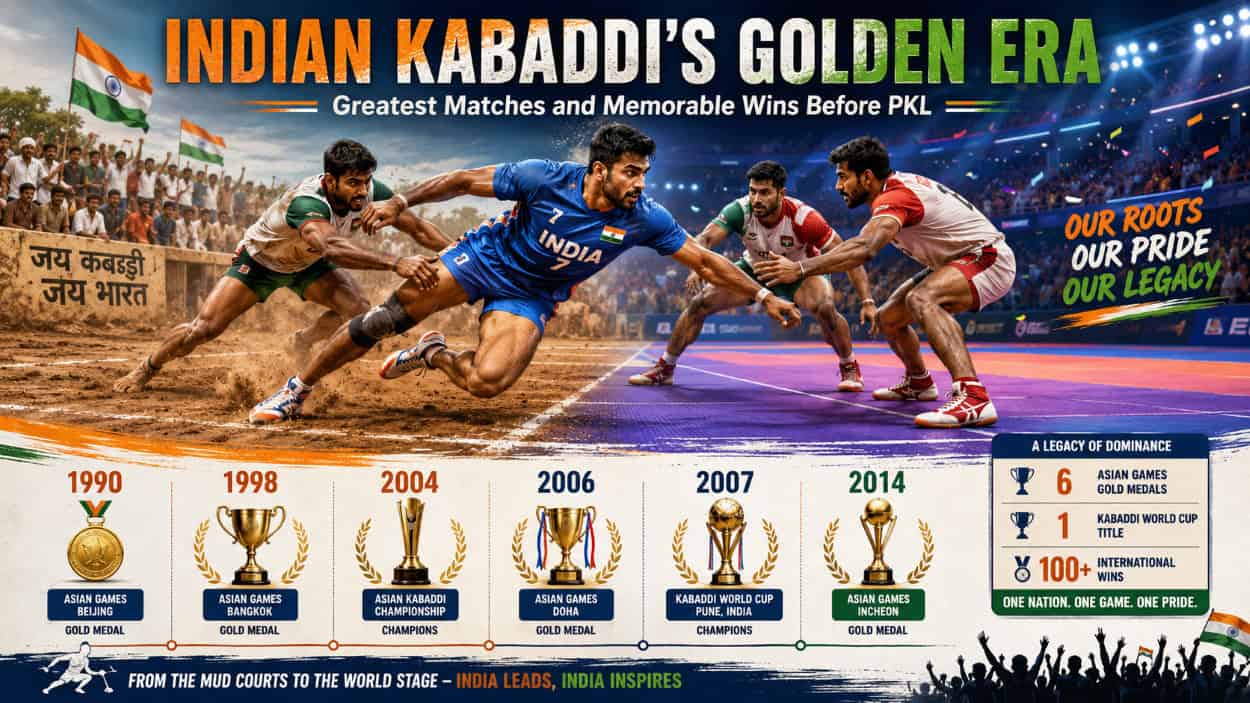
Between 1990 and 2014, the Indian national kabaddi team created one of the most impressive periods of dominance in international sport. Long before the Pro Kabaddi League brought the sport into prime time, India had already established itself as the leading power in kabaddi.
The Indian kabaddi golden era was defined by major tournament victories, fierce rivalries and players who became legends of the sport. India won seven consecutive Asian Games gold medals between 1990 and 2014 and also claimed both editions of the Standard Style World Cup held before the PKL began.
The Golden Era of Indian Kabaddi
The golden era of Indian kabaddi was not limited to success at one tournament. India won all seven Asian Games editions between 1990 and 2014. The team also collected five gold medals at the South Asian Games during that period.
This remarkable run showed the depth of India’s kabaddi system. Players developed their skills through domestic competitions, institutional teams and traditional mud court matches before eventually representing the national team.
1990 Asian Games: The Beginning
Kabaddi became a full-medal sport at the 1990 Asian Games in Beijing. India immediately established its dominance by going unbeaten and winning the inaugural gold medal.
Players such as Shantaram Jadhav, Ashan Kumar and Tirath Raj represented a generation shaped by traditional kabaddi. Their success created the foundation for India’s extraordinary Asian Games record.
The victory was more than the first gold medal. It established India as the team everyone else would have to beat.
1998 Asian Games: India Continue Their Dominance
The 1998 Asian Games in Bangkok provided another important chapter in India kabaddi dominance. Pakistan presented a major physical challenge, but India managed to overcome its arch-rival.
Sanjeev Kumar’s aggressive raiding combined with India’s effective chain tackling helped the team secure another gold medal. The victory kept India’s unbeaten Asian Games record intact and showed that the team could handle intense pressure against Pakistan.
2004 World Cup: India Defeat Iran 55 27
The 2004 Standard Style World Cup in Mumbai marked the beginning of a new chapter. India faced Iran in the final of the inaugural tournament and produced a dominant performance.
India won 55-27, with Sanjeev Kumar and a young Rakesh Kumar playing important roles. India’s multi-point raids and strong defence gave Iran very few opportunities to recover.
The victory gave India its first World Cup title and established the country as the world’s leading force in the new international competition.
2006 Asian Games: Another Victory Over Pakistan
India faced Pakistan in the 2006 Asian Games final in Doha. The match was played under huge pressure, with both teams determined to claim continental supremacy.
Captain Dinesh Kumar and Naveen Kumar helped India deal with Pakistan’s aggressive raids. India eventually won 35-23 to claim its fifth consecutive Asian Games gold.
2007 World Cup: India Retain the Title
Iran returned stronger in the 2007 World Cup final in Panvel. This time, Iran adopted a defence-focused strategy designed to limit India’s raiders.
India responded through disciplined defending. Pankaj Shirsat and Manpreet Singh helped the team execute crucial tackles as India won 29-19.
The victory demonstrated that India’s success was not dependent on attacking brilliance alone.
2014 Asian Games: A Final Thriller
The 2014 Asian Games final in Incheon was one of the closest contests of the era. India faced Iran and had to produce a late comeback to protect its remarkable record.
Rakesh Kumar, Anup Kumar and Ajay Thakur played important roles as India eventually won 27-25. The victory delivered India’s seventh consecutive Asian Games gold medal.
It can also be considered a fitting conclusion to the pre-PKL era, though the inaugural Pro Kabaddi League season began in July 2014, while the Incheon Asian Games took place in September–October 2014.
India’s Lasting Legacy
The Indian kabaddi legacy was built on more than trophies. Players developed through traditional mud courts, while organisations such as Indian Railways, ONGC, Air India and the Services provided employment and competitive opportunities.
The tactical side of the sport also evolved during this period, with specialised roles such as ankle holders, thigh holders and bonus line specialists becoming increasingly important.
When the PKL arrived in 2014, it did not create India’s kabaddi culture. It gave an already successful sport a bigger stage. The Indian kabaddi golden era had already produced a winning tradition that remains the foundation of India’s position at the top of international kabaddi.