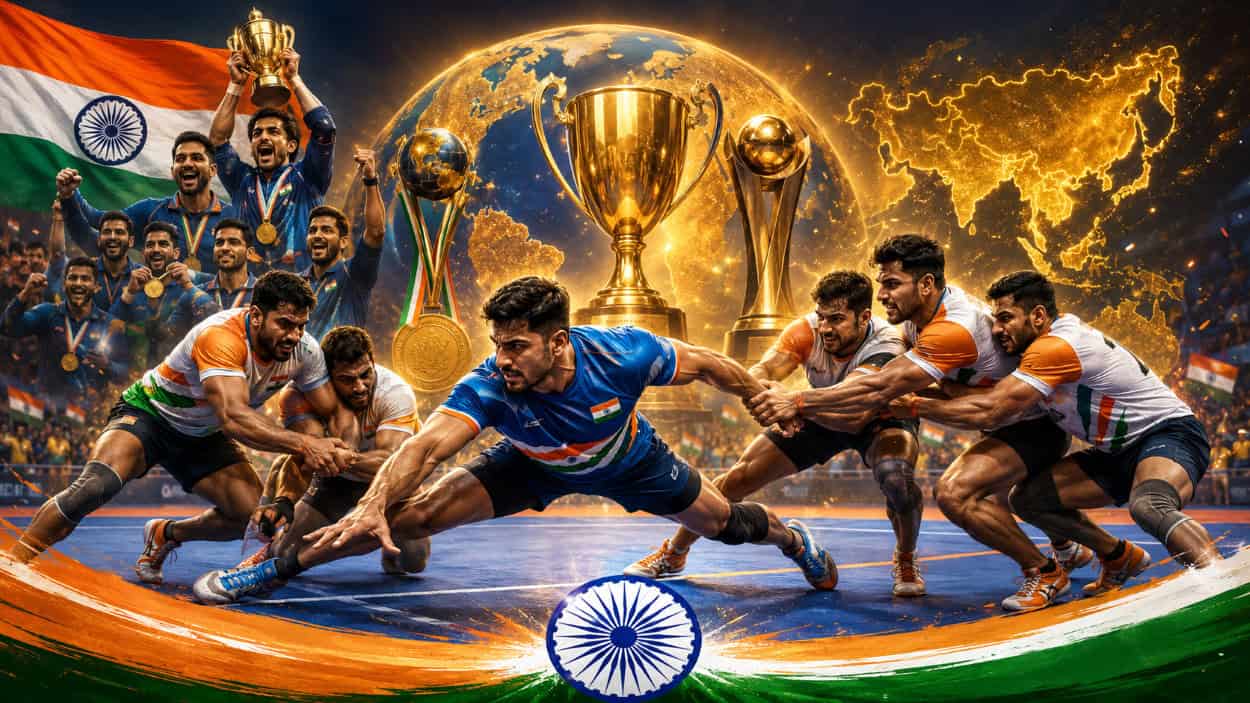
Few countries have dominated a sport as completely as India has dominated kabaddi. From village playgrounds to packed indoor arenas, India has consistently set the standard for excellence, winning major international tournaments and producing generations of world-class players. The story of India kabaddi dominance is built on decades of success, strong grassroots development, and continuous innovation.
India Kabaddi World Champions
India’s greatest achievement has come on the world stage. In standard style kabaddi, the national team has won every major World Cup held so far, underlining its unmatched consistency.
India won the inaugural standard style Kabaddi World Cup in Mumbai in 2004, defeating Iran 55-27 in the final. Three years later, they successfully defended the title in Panvel with another victory over Iran.
The women’s team also enjoyed immediate success, winning the first Women’s Kabaddi World Cup in Patna in 2012 by defeating Iran 25-19. India’s dominance continued in 2016 when they lifted another standard style World Cup in Ahmedabad, once again overcoming Iran in the final.
In 2025, Indian kabaddi celebrated another remarkable year. The women’s team defeated Chinese Taipei 35-28 in the Women’s World Cup final in Dhaka, while the men’s team edged England 44-41 in a thrilling standard style World Cup final in Wolverhampton.
India’s success has not been limited to standard style kabaddi. The men’s team also won six consecutive circle style World Cups between 2010 and 2016, further strengthening the country’s position as the sport’s global powerhouse.
Asian Games Success
The Indian kabaddi history at the Asian Games is equally impressive.
Kabaddi became an official medal sport at the 1990 Asian Games in Beijing, and India immediately established complete control over the competition. The men’s team won seven consecutive gold medals in 1990, 1994, 1998, 2002, 2006, 2010 and 2014, remaining unbeaten for nearly three decades.
That remarkable run finally ended at the 2018 Asian Games in Jakarta. India suffered a surprise group stage defeat to South Korea before losing to Iran in the semi-finals, eventually settling for the bronze medal.
However, India quickly reclaimed its place at the top. At the delayed 2023 Asian Games in Hangzhou, captain Pawan Sehrawat led the team to a dramatic 33-29 victory over Iran in the final, securing India’s eighth Asian Games gold medal.
The Evolution of Indian Kabaddi
India’s dominance has been built over decades rather than achieved overnight.
The sport’s modern journey began in the 1920s when its rules were formally standardised in Maharashtra. A major step came in 1972 with the formation of the Amateur Kabaddi Federation of India (AKFI), which helped organise competitions and develop the game nationwide.
Legendary players like Rakesh Kumar and Anup Kumar transformed kabaddi with smarter tactics, quicker raids and coordinated defensive systems. Their innovations inspired future generations of stars.
The launch of the Pro Kabaddi League in 2014 completely changed the sport. Professional contracts, television coverage and international exposure helped create household names such as Pardeep Narwal, Ajay Thakur and Pawan Sehrawat, while strengthening India’s talent pipeline.
A New Challenge Awaits
Although India kabaddi dominance remains unmatched, the competition has become stronger in recent years. Iran has emerged as India’s biggest rival, while South Korea, Chinese Taipei and Pakistan continue to improve on the international stage.
Even so, India’s unmatched record, consistent production of elite players and rich Indian kabaddi history ensure that the country remains the benchmark in world kabaddi. As the sport continues to grow globally, India remains the team every nation aims to beat.