Kabaddi has evolved into one of the world’s fastest-growing sports, thanks to professional leagues like the Pro Kabaddi League (PKL). However, long before television broadcasts and packed indoor arenas, the game existed in several traditional forms that varied across different regions of India.
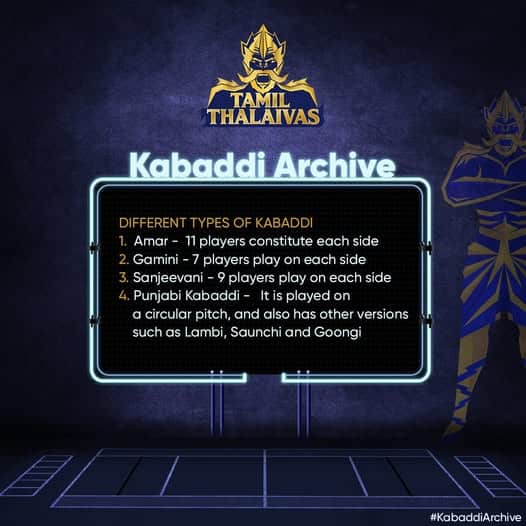
When the All India Kabaddi Federation was established in 1950, it worked to standardize the sport by drawing inspiration from three major styles: Sanjeevani, Gaminee, and Amar. These ancient Kabaddi variants laid the foundation for the modern game while preserving centuries of sporting tradition.
Sanjeevani: The Foundation of Modern Kabaddi
Among all the traditional Kabaddi formats, Sanjeevani is the closest to the game played today.
The defining feature of Sanjeevani Kabaddi rules is the revival system. Whenever a raider successfully dismisses an opponent, that player leaves the court. At the same time, one previously eliminated teammate of the raider’s side is revived and returns to play.
This “one out, one in” principle keeps both teams at full strength throughout most of the match while rewarding successful raids.
Traditional Sanjeevani matches are played with seven players on each side over 40 minutes, divided into two halves.
Another important feature is the Lona, now known as the All Out. If one team dismisses all seven opponents, it earns four bonus points before the opposition returns to the mat.
Modern standard-style kabaddi and PKL rules are directly based on this format.
Gaminee: A Battle of Survival
For anyone looking for Gaminee Kabaddi explained, this version is far more demanding than Sanjeevani.
Unlike the revival-based format, Gaminee offers no second chances. Once a player is tagged out or tackled, they remain out for the rest of that round.
As players leave the court, the defending team becomes smaller, making it increasingly difficult to stop future raids.
Another major difference is the absence of a fixed time limit. Instead of playing for a set duration, teams compete until one side completely eliminates all seven opponents to score a point.
The court then resets, and play continues until a team reaches the agreed winning total, usually five or seven points.
Because of its demanding nature, Gaminee is now rarely played and survives mainly in traditional settings.
Amar: The Continuous Contest
The third of the ancient Kabaddi variants is Amar, whose name means “immortal.”
Unlike Sanjeevani or Gaminee, players are never removed from the court.
Every successful raid or tackle simply earns one point, while all players continue participating without interruption.
This creates a fast-paced contest where stamina, quick decision-making, and continuous teamwork become even more important than player elimination.
Since nobody leaves the mat, there are no All Outs or revival systems in Amar.
This format later became the basis for Circle-style Kabaddi, which remains extremely popular in Punjab, Haryana, and among international kabaddi communities.
The Lasting Legacy
Although today’s professional game follows the Sanjeevani model, all three traditional Kabaddi formats have contributed to the sport’s development.
Sanjeevani introduced the structured revival system that defines international kabaddi today. Gaminee showcased the importance of survival and tactical discipline, while Amar inspired the continuous action seen in Circle-style competitions.
Understanding these ancient Kabaddi variants offers a deeper appreciation of how kabaddi evolved over centuries. The modern game may feature advanced technology, television coverage, and global tournaments, but its roots remain firmly connected to these timeless traditional formats that helped shape one of India’s greatest sporting traditions.