The launch of the First Pro Kabaddi League season in 2014 marked a historic turning point for kabaddi in India. Before the league began, the sport was largely associated with rural areas, mud courts, and local tournaments. While India had enjoyed success in international kabaddi, the sport struggled to attract mainstream attention, commercial investment, and television audiences.
Everything changed when Mashal Sports, co-founded by Anand Mahindra and Charu Sharma, partnered with Star Sports to launch the Pro Kabaddi League (PKL). Inspired by the franchise model of the Indian Premier League, the competition transformed kabaddi into one of India’s biggest sporting events almost overnight.
From Mud Courts to Modern Arenas
One of the biggest ways how PKL changed kabaddi was the complete transformation of how the sport was presented.
Traditional mud courts were replaced with modern indoor synthetic mats, making matches faster, safer, and more visually appealing. High-definition broadcasts, multiple camera angles, slow-motion replays, dramatic lighting, and energetic commentary gave kabaddi a professional look that appealed to television viewers.
The caravan format also played a major role in the league’s success. Instead of remaining in one city, the tournament travelled across all eight franchise locations, helping teams build loyal fan bases in different parts of the country.
Rule Changes Increased Entertainment
The PKL 2014 history is also remembered for introducing exciting rule changes that made the game more attractive for television audiences.
The 30-second raid clock forced raiders to make quick decisions instead of slowing down the game. The introduction of the Do-or-Die Raid ensured teams could not play overly defensive cricket-like strategies, while the Super Tackle rewarded defenders with two points if they stopped a raider despite having only three or fewer players on the mat.
These innovations increased the pace of matches and created more dramatic moments for fans.
A Memorable First Season
The inaugural tournament was held between July 26 and August 31, 2014, featuring eight franchises and a total of 60 matches.
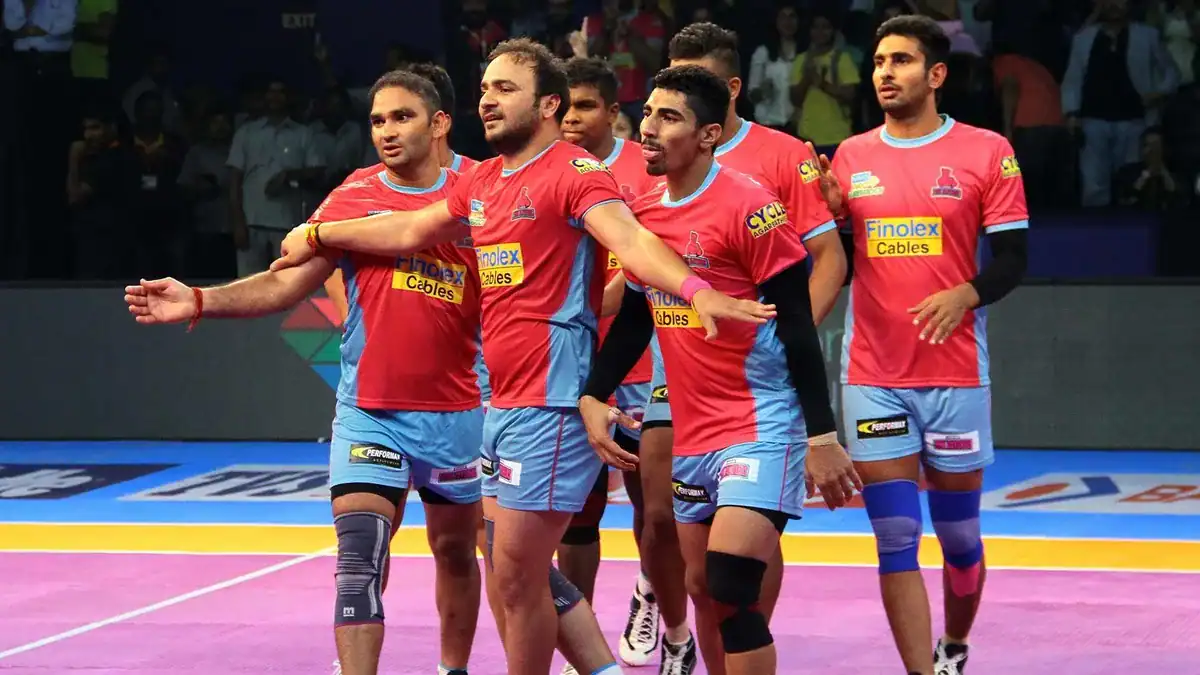
Jaipur Pink Panthers became the first champions after defeating U Mumba 35-24 in the final at Mumbai’s Sardar Vallabhbhai Patel Indoor Stadium.
U Mumba captain Anup Kumar finished as the season’s top raider with 169 raid points, while Manjeet Chhillar of Bengaluru Bulls and Surender Nada of U Mumba shared the top defender award with 51 tackle points each.
The player auction also attracted attention, with Rakesh Kumar becoming the highest paid player after joining Patna Pirates for ₹12.80 lakh.
Record-Breaking Popularity
Many questioned whether kabaddi could attract large television audiences. The first Pro Kabaddi League season quickly provided answers.
The inaugural edition reached more than 435 million viewers across India, while the final alone attracted 86.4 million viewers. These numbers made PKL the second most watched sporting league in the country after the IPL.
Its success proved that Indian audiences were willing to support sports beyond cricket when presented professionally.
A Lasting Legacy
Perhaps the biggest achievement of how PKL changed kabaddi was its impact on players and the sport’s future. Athletes who were once known only in regional circles suddenly became national stars with lucrative contracts and endorsement opportunities.
The league also attracted international players from countries such as Iran, South Korea, Kenya, and Bangladesh, raising the standard of competition. At the grassroots level, kabaddi academies expanded rapidly as more young athletes saw the sport as a genuine career option.
More than a decade later, the PKL 2014 history remains one of the most important chapters in Indian sport, proving that with the right vision, presentation, and investment, a traditional game could become a modern sporting phenomenon.