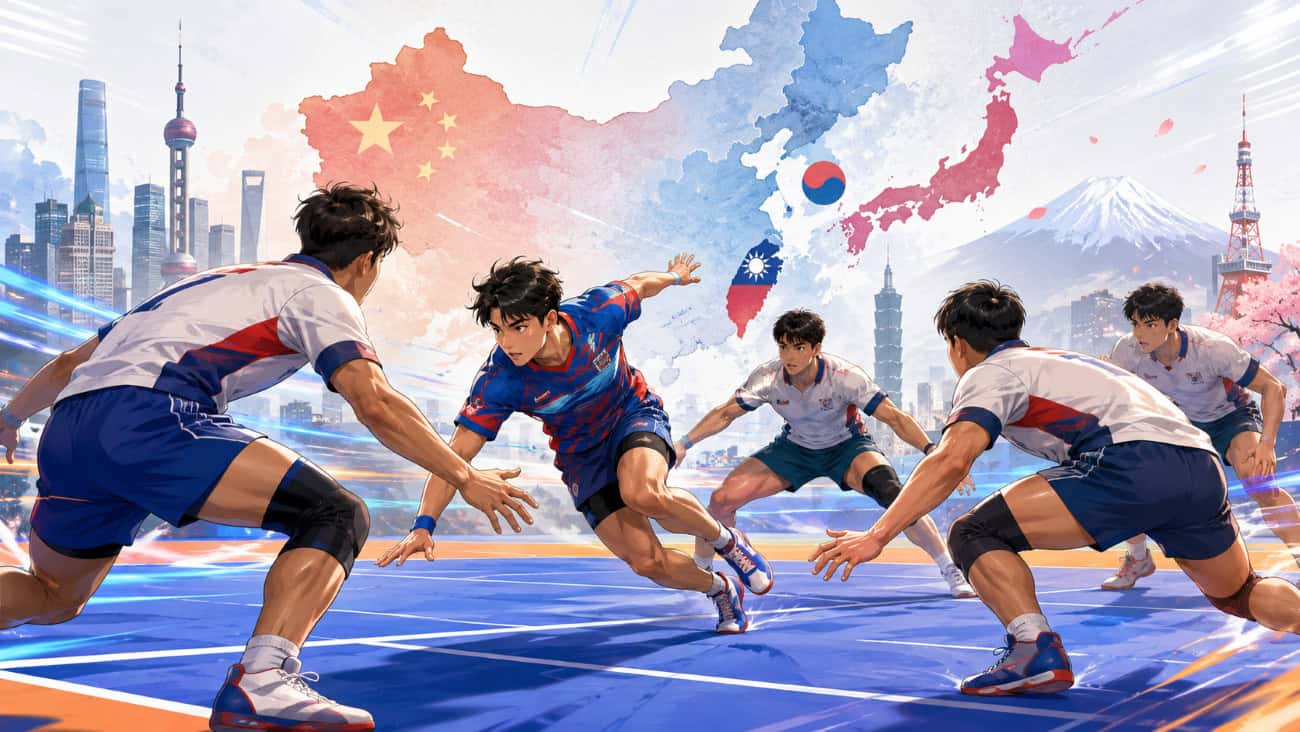
Kabaddi has long been associated with South Asia, but over the last decade, the sport has found an unexpected home in East Asia. Through a mix of popular culture, grassroots development, and international competition, countries like Japan, South Korea, and Chinese Taipei have embraced the game and helped fuel the Growth of Kabaddi in East Asia.
Today, East Asia is not just participating in kabaddi. It is producing competitive teams, professional players, and a new generation of fans who discovered the sport in unique ways.
How Anime Introduced Kabaddi to Japan
One of the biggest reasons behind the International Kabaddi expansion in Japan came from an unlikely source—anime.
In 2021, TMS Entertainment released Burning Kabaddi, the anime adaptation of the popular manga Shakunetsu Kabaddiby Hajime Musashino. The story follows former football player Tatsuya Yoigoshi, who reluctantly joins his school’s kabaddi club before discovering the sport’s intensity and strategy.
The series presented kabaddi as much more than a simple tag game. Through dramatic raids, tactical battles, and fast paced action, the anime highlighted the physical and mental challenges involved in the sport.
This connection between Kabaddi and anime culture inspired many young viewers to explore the game in real life. Universities across Japan began forming amateur kabaddi clubs, introducing a new audience to a sport they had never previously considered.
South Korea’s Competitive Rise
While Japan experienced kabaddi through entertainment, South Korea focused on building success on the mat.
The Korea Kabaddi Association introduced the sport into schools and promoted it as a way to improve teamwork, agility, and fitness. The long term investment produced impressive results.
South Korea made headlines at the 2018 Asian Games by defeating India 24-23 during the group stage, one of the biggest upsets in kabaddi history. The team eventually won the silver medal, proving they could compete with the world’s best.
A major figure in this success was Lee Jang-kun. Known as one of the finest international raiders in the Pro Kabaddi League, Lee became a household name in South Korea through both his sporting achievements and television appearances. His popularity helped bring kabaddi into mainstream conversation.
A New Regional Rivalry
The sport’s growth eventually led to the creation of the Men’s East Asia Kabaddi Championship, strengthening competition across the region.
Japan quickly established itself as a tactical powerhouse by winning the inaugural championship in 2025. South Korea continued to rely on speed, defensive coordination, and physical fitness, while Chinese Taipei developed a reputation for sharp mat awareness and rapid defensive improvement.
These competitions have helped build a strong regional identity for kabaddi outside its traditional heartland.
The Future Looks Promising
The Growth of Kabaddi in East Asia is showing no signs of slowing down.
Japan continues to benefit from university programs and the influence of anime. South Korea has built a successful pathway from schools to international competition, while Chinese Taipei is making steady progress through regional tournaments.
Together, these nations are changing the global landscape of kabaddi. Their success proves that the sport can thrive far beyond South Asia when supported by strong development programs and creative cultural influences.
From television screens to international arenas, the journey of Kabaddi and anime culture demonstrates how sport and entertainment can work together to inspire new generations. As International Kabaddi expansion continues, East Asia is set to play an increasingly important role in shaping the future of the game.