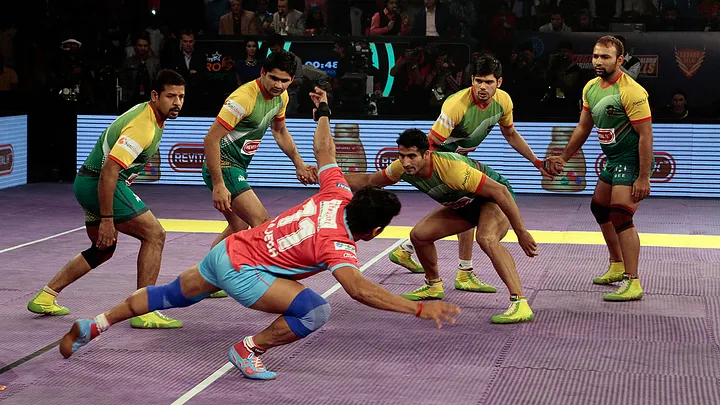
Kabaddi has changed dramatically over the last decade. Earlier, defenders mostly relied on strength and direct body contact to stop raiders. But modern raiders are faster, smarter, and far more creative than before. Skills like the dubki, frog jump, running hand touch, and bonus escape have forced defenses to completely rethink their strategies.
That tactical shift has made the “chain tackle evolution in kabaddi” one of the biggest developments in the modern game. Teams are no longer depending only on individual tackles. Instead, they are using coordinated defensive systems to stop dangerous super raids before they happen.
Why Modern Raiders Forced Defensive Changes
The rise of aggressive raiders in the Pro Kabaddi League changed the balance of the sport. Players began scoring multiple points in a single raid more regularly, creating the era of the super raid. A super raid happens when a raider scores three or more points in one attack. (Sports Board India)
Modern raiders use speed, agility, and quick direction changes to target weak defensive links. Reddit discussions among kabaddi fans also highlight how skills like the dubki and jump attacks made defenses more hesitant and vulnerable to multi-point raids. (Reddit)
Because of this, teams realized that isolated tackles were becoming too risky. One missed tackle could lead to a huge momentum swing and even an all-out.
The Evolution of the Chain Tackle
The answer came through the development of smarter team defending. The chain tackle became the most reliable solution against explosive raiders.
A chain tackle happens when two or more defenders hold hands or link together while closing down the raider’s movement space. (Sports Vichar)
Earlier versions of the chain tackle were mostly static. Defenders simply tried to surround the raider with physical strength. Modern kabaddi defensive systems are far more tactical.
Today, defenders move as a synchronized unit. Corners and covers communicate constantly, adjusting angles depending on the raider’s body position and footwork. Instead of rushing immediately, defenses often wait for the raider to commit to one side before triggering the tackle.
This evolution has helped teams reduce the open gaps that modern raiders usually exploit.
How Chain Tackles Stop Super Raids
One of the main reasons behind the growth of modern kabaddi defensive tactics is the need to stop four-point super raids.
Modern chain tackles are designed to remove escape routes. Raiders depend heavily on quick turns and last-second movement to break free. A connected defensive line limits those options.
Sports analysis pieces on kabaddi explain that chain tackles are especially effective against skills like the dubki and frog jump because linked defenders create a tighter defensive wall. (Sports Vichar)
Teams also use delayed chain tackles now. Instead of attacking instantly, defenders allow the raider to move deeper into the court before the corners and covers collapse together. This traps the raider further away from the midline and reduces the chance of escape.
Communication has also become critical. Defenders constantly call movements and timing to avoid breaking the chain during contact. (Sports Vichar)
The Rise of Defensive Analytics
Another major reason behind the tactical improvement is video analysis and data preparation. Coaches now study raider habits carefully before matches.
The Pro Kabaddi League itself noted how analytics and detailed breakdowns helped defenses improve their tackling systems and super tackle efficiency over recent seasons. (Pro Kabaddi League)
Teams now identify which side a raider prefers, how they escape pressure, and when they attempt bonus points. Defensive chains are then adjusted based on those patterns.
The Future of Kabaddi Defense
The “best chain tackle strategies kabaddi” discussion continues to grow because the sport keeps evolving every season. Raiders are becoming more athletic and unpredictable, which means defenses must remain flexible and coordinated.
Modern kabaddi is no longer just about individual brilliance. Successful teams now depend heavily on synchronized defending, tactical positioning, and collective pressure.
The chain tackle has evolved from a basic defensive move into a complete tactical system designed to stop the explosive super raids that define today’s game.