When fans talk about international kabaddi today, the focus often shifts to the Pro Kabaddi League (PKL) or recent global competitions. However, the roots of modern international Kabaddi can be traced back to the early 2000s, when the International Kabaddi Federation (IKF) launched the first standard-style World Cups.
These pioneering events played a crucial role in the history of international Kabaddi, bringing together teams from different continents and laying the foundation for the sport’s global growth. While they may not have received the attention of today’s tournaments, these competitions remain an important chapter in Kabaddi World Cup history.
The 2004 Kabaddi World Cup
The first edition of the IKF World Cup was held in Mumbai from November 19 to 21, 2004. It marked a historic moment as 12 nations competed under a unified format for the first time.
The tournament featured traditional Asian powers alongside emerging nations such as Germany, Canada, Great Britain, Japan, and the West Indies. This diverse lineup showed the ambition to expand kabaddi beyond South Asia.
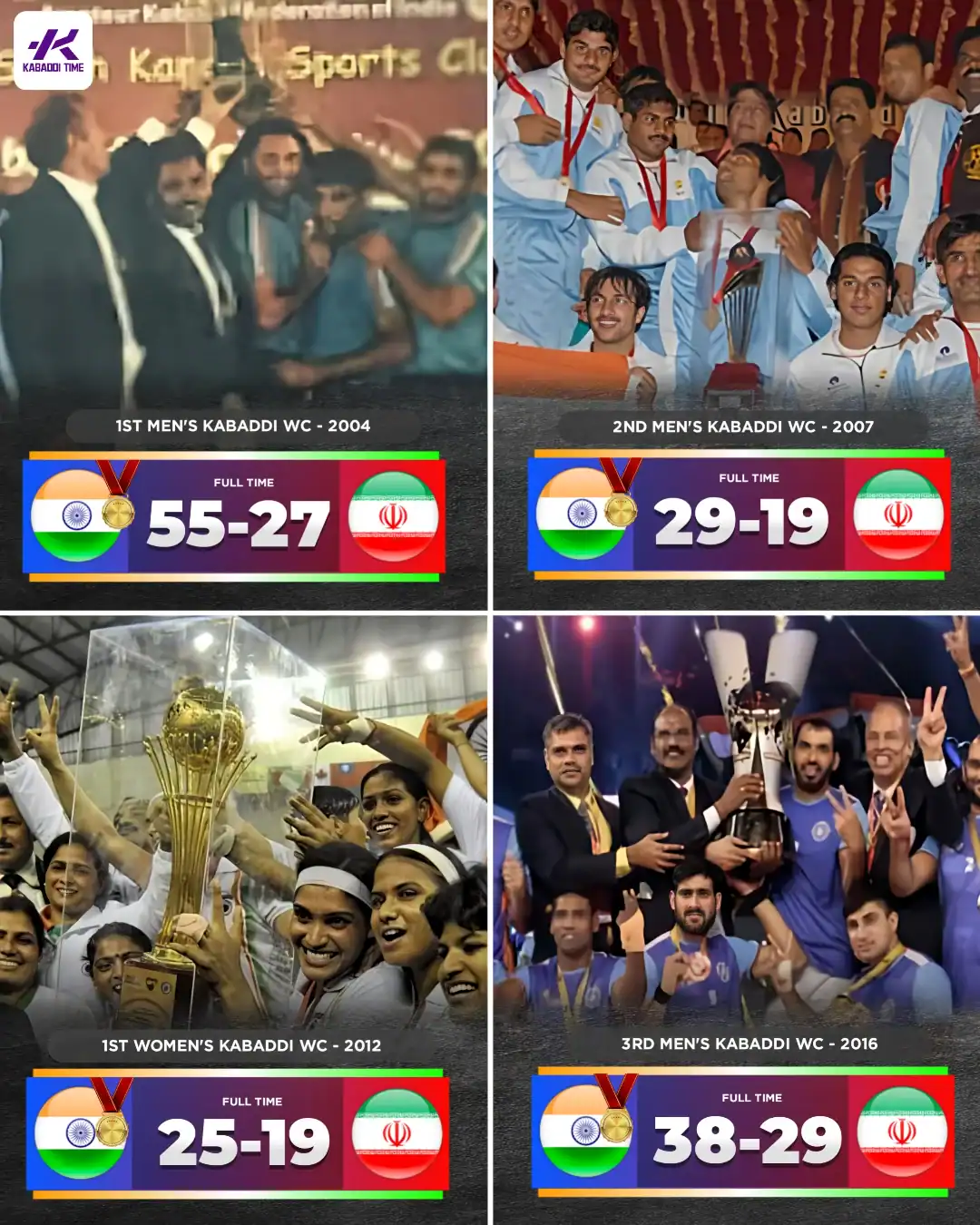
India dominated the inaugural tournament and defeated Iran 55-27 in the final to become the first world champions. Star raider Sanjeeva Kumar delivered a match winning performance, scoring 17 points in the title clash and earning recognition as one of the tournament’s standout players.
Bangladesh and Canada finished as joint third place teams, underlining the growing competitiveness of the international game.
The 2007 World Cup
The second edition of the Kabaddi World Cup in the 2000’s was held in Panvel, Maharashtra, in January 2007.
The tournament expanded to 14 participating nations, reflecting the sport’s steady international growth. Teams like Thailand, Malaysia, South Korea, and Japan continued to improve, making the competition stronger than the inaugural edition.
Once again, India and Iran emerged as the two best teams and met in the final. This time, Iran offered much tougher resistance by improving their defensive strategy and slowing the pace of the game.
Despite the challenge, India’s experience proved decisive as they secured a 29-19 victory to defend their world title. Bangladesh and Japan shared third place, highlighting the increasing strength of teams outside the traditional favorites.
Why These Tournaments Matter
The early historic Kabaddi tournaments did much more than crown champions.
One of their biggest achievements was standardizing the rules of international Kabaddi. Before these events, different countries followed different playing formats and court dimensions. The World Cups introduced the indoor standard style that is now used across major international competitions.
The tournaments also established the seven-player format, standardized mat dimensions, and the bonus line system that fans now associate with modern kabaddi.
Building the Future
Perhaps the greatest legacy of these competitions was helping Kabaddi become a truly international sport.
Iran’s back to back runner up finishes proved they could challenge India on the world stage, eventually paving the way for their Asian Games success in later years.
Countries such as Japan and South Korea also gained valuable international experience, producing players who would later feature in the Pro Kabaddi League.
While today’s Kabaddi enjoys packed stadiums, television audiences, and professional leagues, those achievements were built on the foundation laid by the Kabaddi World Cup 2000s. These early tournaments proved that Kabaddi could attract global participation and created the roadmap for the sport’s continued international growth.
Their contribution to Kabaddi World Cup history deserves far greater recognition as the events that transformed Kabaddi from a regional pastime into an international sport.