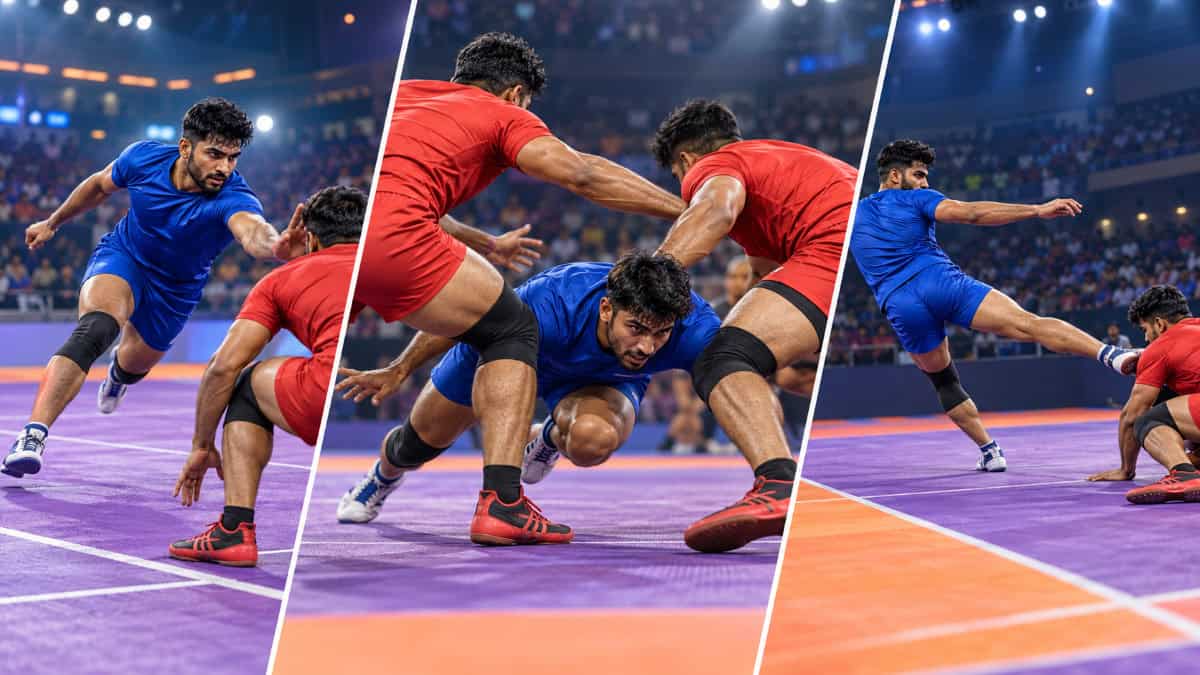
Raiding is one of the most important skills in kabaddi, requiring a combination of speed, agility, technique and tactical awareness. In modern competitions such as the Pro Kabaddi League (PKL), successful raiders must master traditional moves while adapting to increasingly organised defensive strategies.
From the running hand touch and toe touch to advanced movements such as the dubki and scorpion kick, each raiding technique serves a specific purpose.
Understanding these skills, along with the rules governing different scoring situations, can help players improve their attacking abilities and make better decisions during matches.
What Is a Raid in Kabaddi?
A raid begins when an attacking player crosses the midline into the opposing team’s half. The raider attempts to score points by touching defenders and returning safely to their own half without being tackled. Points may also be earned through a legal bonus-line crossing or certain defensive rule violations.
In traditional kabaddi, the raider must maintain a continuous chant of “kabaddi,” known as the cant, throughout the attack.
In professional competitions such as the PKL, each raid has a maximum duration of 30 seconds, making quick decisions and effective movement essential.
Raiders generally earn one point for each defender they legally touch before returning safely. Bonus points are also available when the required conditions are met.
1. Running Hand Touch
The running hand touch is a popular attacking technique that combines acceleration with precise hand movement.
The raider approaches defenders at speed, extends an arm to make contact and quickly retreats towards the midline.
This technique is particularly useful against defenders who leave space or react slowly to sudden movement.
Main advantage: Creates quick scoring opportunities through speed and surprise.
2. Toe Touch
The toe touch requires flexibility, balance and accurate timing.
A raider lowers their body or extends a leg to touch a defender with the toes while maintaining enough distance to avoid being tackled.
The technique is frequently used against corner defenders who position themselves near the edge of the defensive formation.
Successful execution depends on reaching the defender without losing balance or allowing an easy ankle hold.
Main advantage: Allows raiders to score while keeping their upper body away from defenders.
3. Dubki
The dubki is an advanced evasive technique used when defenders attempt to surround or tackle a raider.
The attacking player bends low and moves underneath or through defenders’ arms, often escaping a defensive chain.
Unlike a hand touch or toe touch, the dubki is primarily an escape movement rather than a separate scoring-touch technique.
The move requires exceptional body control, flexibility and awareness of the defenders’ positions. A well-executed dubki can turn a dangerous tackle situation into a successful raid by allowing the attacker to escape and return to their own half.
Main advantage: Helps raiders escape coordinated defensive tackles.
4. Frog Jump and Lion Jump
Frog jumps and lion jumps are advanced aerial movements that allow raiders to evade approaching defenders. Although the techniques share similarities, their execution and terminology can vary depending on coaching methods and playing styles.
A frog jump generally involves a powerful leap from a lowered body position, helping the raider clear a low tackle.
A lion jump is commonly associated with a more explosive forward or upward movement over an approaching defender.
Both techniques demand leg strength, balance, body control and accurate timing. Raiders may use these movements when defenders attempt low tackles or block the most direct route back to the midline.
However, an unsuccessful jump can leave the raider vulnerable to a tackle or cause them to lose balance.
Main advantage: Creates an escape route over defenders, particularly during low tackling attempts.
5. Hand Touch
The hand touch is one of the fundamental attacking skills in kabaddi. Unlike the running hand touch, which relies heavily on acceleration, a conventional hand touch can be executed from different positions and speeds.
Raiders use quick arm extensions, changes of direction and controlled body movements to make contact with defenders.
The technique is particularly effective when defenders move within touching distance or attempt to close down space.
Main advantage: Provides a versatile scoring option in different attacking situations.
6. Back Kick and Side Kick
Back kicks and side kicks allow raiders to score touch points without facing a defender directly.
A back kick involves extending the leg behind the body to touch an approaching opponent.
A side kick uses a sideways leg movement to reach defenders positioned beside the raider.
Both techniques require good spatial awareness because the raider may not have a clear view of the target. They also demand balance and controlled movement to avoid losing position after making contact.
Main advantage: Helps catch defenders approaching from the side or behind.
7. Scorpion Kick
The scorpion kick is one of kabaddi’s more difficult attacking techniques.
The raider bends the upper body forward and lifts a leg upward and backward, attempting to touch a defender positioned behind or slightly beyond normal reach. The movement resembles a scorpion’s raised tail.
Successful execution demands flexibility, coordination, balance and precise timing. Because of its difficulty, the scorpion kick is generally associated with highly skilled raiders rather than beginners.
Main advantage: Offers an unexpected way to reach defenders who believe they are safely positioned.
8. Feint and Touch
The feint and touch combines deception with quick attacking movement: the raider initially threatens one side of the defensive formation, encouraging defenders to shift their positions.
The raider then changes direction and attempts to touch an opponent through the space created.
This technique relies on reading defensive reactions rather than physical speed alone. Successful execution requires convincing body movement, quick decision-making and precise timing.
Main advantage: Creates openings by disrupting defenders’ positioning.
Different Types of Strategic Raids in Kabaddi
Alongside individual attacking techniques, raiders must understand several important scoring situations and raid classifications.
These are not physical techniques like hand touches or dubkis. Instead, they describe circumstances that affect scoring, tactics and decision-making.
Do-or-Die Raid
Under PKL rules, a Do-or-Die raid occurs when a team’s previous two raids have ended without scoring a raid point. The team’s third consecutive raid becomes a Do-or-Die opportunity.
The raider must score a raid point during this attempt. If the raid ends without one, the raider is declared out and the defending team receives a point.
These situations place significant pressure on attackers and can influence match momentum. Do-or-Die raids often encourage more aggressive attacking decisions because returning without a raid point is no longer a safe option.
Super Raid
A Super Raid occurs when a raider scores three or more raid points during a single raid. Such attacks can dramatically change a match by removing multiple defenders and creating opportunities for subsequent raids.
A Super Raid should not be confused with a Super 10, which is achieved when an individual player accumulates at least ten raid points during a match.
Successful Super Raids require excellent timing, awareness and attacking execution.
Bonus-Point Attempt
A bonus point can be earned when a raider legally crosses the bonus line while the defending team has at least six players on the mat. Under standard bonus-line rules, the raider must cross the bonus line with one foot while the trailing foot is off the ground. No part of the raider’s body should be touching the ground between the bonus line and the end line during the qualifying movement.
The bonus provides an additional scoring opportunity without requiring the raider to touch a defender.
However, earning a bonus point does not automatically guarantee a successful return. The raider must still avoid being tackled to prevent the defending team from scoring a tackle point.
A bonus-point attempt is better understood as a scoring opportunity within a raid rather than a separate official raid classification.
Kabaddi Raiding Techniques: Quick Comparison
Kabaddi attacking skills can be divided into touch techniques, evasive movements and tactical scoring situations.
| Category | Technique or Situation | Primary Benefit |
|---|---|---|
| Touch technique | Running Hand Touch | Fast touch points |
| Touch technique | Toe Touch | Reaches defenders from a distance |
| Evasive movement | Dubki | Escapes defensive chains |
| Evasive movement | Frog Jump | Avoids low tackles |
| Evasive movement | Lion Jump | Clears approaching defenders |
| Touch technique | Hand Touch | Versatile scoring |
| Touch technique | Back Kick | Reaches defenders behind the raider |
| Touch technique | Side Kick | Targets defenders to the side |
| Touch technique | Scorpion Kick | Reaches difficult targets |
| Deceptive movement | Feint and Touch | Creates defensive gaps |
| Tactical situation | Do-or-Die Raid | Requires a scoring raid |
| Raid classification | Super Raid | Three or more raid points |
| Scoring opportunity | Bonus-Point Attempt | Offers an additional point |
Understanding these distinctions helps players recognise when to use a particular movement and how different scoring rules influence their decisions.
Physical Skills Required for Successful Raiding
Modern kabaddi demands more than knowledge of attacking techniques. Raiders must develop several physical abilities to perform consistently throughout a match.
Core strength: Helps maintain balance, resist tackles and control difficult body movements.
Explosive speed: Allows raiders to accelerate quickly and escape defenders.
Flexibility: Supports advanced techniques such as toe touches, dubkis and scorpion kicks.
Endurance: Helps players maintain performance across repeated raids during a standard 40-minute senior professional match.
Agility: Enables sudden changes of direction and effective responses to defensive pressure.
Coordination: Helps raiders combine attacking movements with controlled landings and quick recoveries.
Combining these qualities with regular technical practice improves overall raiding performance.
Why Tactical Awareness Matters in Kabaddi
Successful raiders must understand how defenders react in different situations. Video analysis can help identify opponents’ preferred tackling techniques, defensive weaknesses and movement patterns.
Raiders also need to manage the 30-second raid clock effectively in professional competitions. Quick attacks may surprise defenders, while slower approaches can help control the tempo when a team is protecting a lead.
However, raiders must remain aware of the remaining time and the consequences of returning without scoring. Mental composure is particularly important during Do-or-Die raids, when failing to earn a raid point results in the raider being declared out.
The ability to remain calm and select the correct technique often separates experienced raiders from developing players.
How Can Beginners Improve Their Kabaddi Raiding Skills?
Players learning kabaddi should begin with fundamental techniques before attempting advanced moves. Running hand touches, basic hand touches and controlled toe touches provide a foundation for developing attacking confidence.
Beginners should also practise footwork, balance, changes of direction and safe movement back towards the midline. As players improve their balance and agility, they can gradually practise more demanding techniques such as dubkis, jumps and specialised kicks.
Advanced movements should be introduced under qualified coaching supervision to reduce the risk of injury. Training under an experienced coach can help players correct technical mistakes and select movements suited to their physical abilities.
Regular match practice is equally important because successful raiding depends on recognising defensive patterns under pressure.
Frequently Asked Questions
What are the main types of raids in kabaddi?
Common raiding techniques include running hand touch, toe touch, dubki, frog jump, lion jump, hand touch, back kick, side kick, scorpion kick and feint and touch.
Do-or-Die raids and Super Raids describe tactical situations or scoring achievements rather than individual physical techniques.
What is the difference between a hand touch and a toe touch?
A hand touch involves contacting a defender with the hand, while a toe touch uses an extended foot to reach an opponent.
Both techniques require accurate timing and a safe return to the raider’s own half.
What is a Super Raid in kabaddi?
A Super Raid occurs when a raider scores at least three raid points during a single raid.
What is a Do-or-Die raid?
Under PKL rules, a Do-or-Die raid is the third consecutive raid after two empty raids by the same team.
The raider must earn a raid point or be declared out, awarding the defending team a point.
What is a dubki in kabaddi?
A dubki is an evasive technique in which a raider lowers their body to move underneath defenders’ arms or escape a defensive chain.
How does a bonus point work in kabaddi?
A raider can earn a bonus point by legally crossing the bonus line when at least six defenders are on the mat.
The crossing must satisfy the applicable foot-position and body-contact requirements.
How long does a raid last in professional kabaddi?
In the Pro Kabaddi League, a raid has a maximum duration of 30 seconds.
Other forms of kabaddi may follow different rules.
What is the difference between a Super Raid and a Super 10?
A Super Raid occurs when a player scores at least three raid points in one raid.
A Super 10 is achieved when a player accumulates ten or more raid points during a single match.
Why is coaching important for kabaddi raiders?
Experienced coaches help players develop correct techniques, improve physical conditioning and understand tactical situations.
Coaching is particularly important when learning advanced movements such as dubkis, aerial jumps and specialised kicks.
Conclusion
Kabaddi raiding combines technical skill, physical preparation and intelligent decision-making. Basic movements such as hand touches and toe touches remain essential, while advanced techniques including dubkis, frog jumps and scorpion kicks provide additional attacking options.
Understanding tactical situations such as Do-or-Die raids, Super Raids and bonus-point opportunities is equally important.
Players who consistently improve their fundamentals, analyse defenders and adapt their techniques are better equipped to succeed in modern competitive kabaddi.