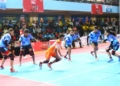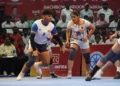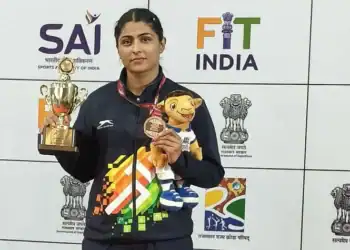
The International Premier Kabaddi League 2026 concluded its European edition after five days of intense action at Sportcampus Zuiderpark in The Hague, Netherlands. Held from August 12 to August 16, the tournament brought professional mat kabaddi to a wider European audience while creating a competitive platform for both established and emerging players.
Organized by the Netherlands Kabaddi Federation in partnership with international sporting bodies, the tournament featured separate men’s and women’s championships. Sports Vision TV and SportVot provided broadcast and streaming coverage, while former India star Mohit Chhillar served as tournament mentor.
International Premier Kabaddi League 2026 Results
The men’s championship featured six teams – Delhi Diamond, Amsterdam Flying Dutchmen, London Royal Lions, Berlin Black Eagle, Copenhagen Thunder Vikings and Oslo Nordic Wolves.
The women’s championship consisted of four teams – Delhi Diamond Women, Amsterdam Flying Dutchwomen, Budapest Mighty Bulls Women and Berlin Black Eagle Women.
The competition followed a league stage before moving into the playoffs, with the final matches taking place on August 16. The closing day, branded as Super Sunday, brought both championship contests together in front of an indoor crowd at Sportcampus Zuiderpark.
The International Premier Kabaddi League 2026 results reflected a competitive tournament, with several matches being decided during the final raids and defensive sequences.
Champion: Oslo Nordic Wolves
Runner-Up: Delhi Diamonds
Final Score: Oslo Nordic Wolves 67 — 39 Delhi Diamonds
IPKL 2026 Winners and Standout Performers
The tournament produced strong performances from both Indian and European players. Delhi Diamond and Amsterdam Flying Dutchmen featured some of the most productive men’s raiders, who consistently attacked the bonus line and used quick running hand touches to collect points.
Oslo Nordic Wolves won the championship by defeating the Delhi Diamonds with a score of 67–39 in the Grand Final.
The 30-second raid clock created a faster tactical environment. Raiders had little time to wait for defensive mistakes and were often required to make quick decisions before returning to safety.
Defenders also played a major role throughout the tournament. Cover and corner combinations showed improved coordination on the synthetic indoor mats, with Super Tackles regularly changing the momentum of matches.
The women’s competition provided another major highlight. Delhi Diamond Women and Amsterdam Flying Dutchwomen displayed aggressive toe touches and disciplined chain tackles, highlighting the growing depth of women’s kabaddi in Europe.
Key Moments
One of the tournament’s major promotional moments came before the European competition with the official corporate trophy launch in Dubai.
Once the tournament began, the group stage produced several entertaining clashes involving London Royal Lions, Copenhagen Thunder Vikings and Berlin Black Eagle. Several matches went down to the final raid, keeping the outcome uncertain until the closing seconds.
Super Tackles were another recurring feature. Teams that appeared to be under pressure were able to produce consecutive two-point tackles and dramatically change the direction of matches.
The tournament eventually reached its climax on August 16, with the men’s and women’s championship matches bringing the five-day event to a close.
IPKL 2026 Tournament Review and Analysis
The IPKL 2026 tournament review highlights the importance of adapting to faster indoor conditions. The smooth European mats encouraged high-speed raiding and favoured agile players capable of producing short bursts of acceleration.
Defensively, successful teams relied on coordinated three-player chains. Corners and covers worked together to restrict escape routes and force raiders towards the sidelines.
Another important feature was the integration of Indian domestic experience with emerging European talent. This combination helped improve tactical decision making, particularly around bonus-line defence and managing the clock during the final stages.
The IPKL 2026 winners ultimately emerged from a tournament that offered much more than competition. The European edition demonstrated the potential for kabaddi to develop a sustainable international ecosystem through professional organization, cross-border participation and exposure to modern mat formats.