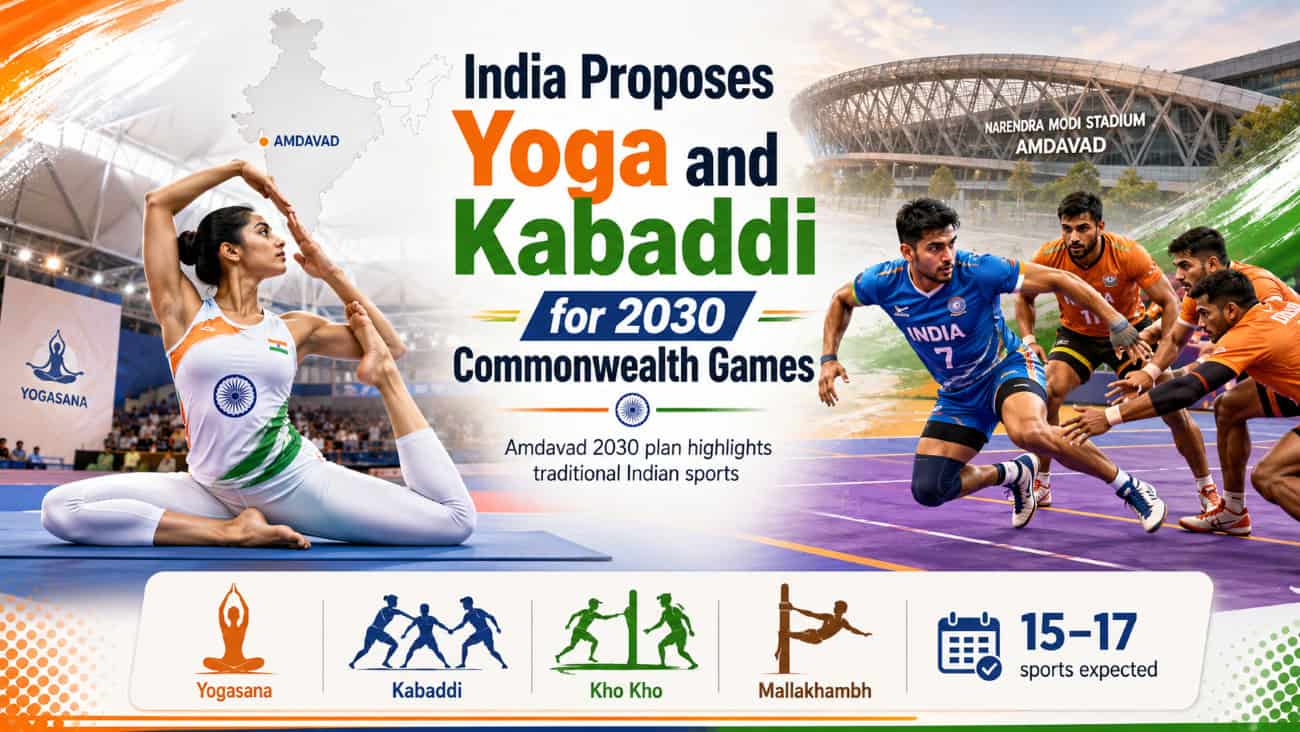
India has taken a major step towards promoting its traditional sports on the global stage by proposing the inclusion of Yogasana and Kabaddi in the 2030 Commonwealth Games. As Amdavad (Ahmedabad) prepares to host the centenary edition of the Games, the Indian government is aiming to showcase the country’s rich sporting heritage through its India Commonwealth Games proposal.
Union Sports Minister Dr. Mansukh Mandaviya confirmed that discussions have already taken place with senior officials from the Commonwealth Games Federation (CGF), including CGF President Dr. Donald Rukare. The talks focused on adding indigenous sports such as Yogasana, Kabaddi, Kho Kho, and Mallakhambh to the official competition schedule.
Expanded Sports Programme for 2030
Unlike the Glasgow 2026 Commonwealth Games, which will feature only 10 sports, the 2030 edition is expected to include between 15 and 17 disciplines.
The Commonwealth Games Federation has introduced greater flexibility for host nations, allowing them to recommend optional sports that reflect their local sporting culture. India plans to use this opportunity to include traditional disciplines that have grown significantly in popularity over recent years.
This flexibility has strengthened the India Commonwealth Games proposal, with Yoga and Kabaddi emerging as two of the strongest candidates for inclusion.
Yoga and Kabaddi Lead India’s Push
One of the biggest goals of the Yoga Commonwealth Games 2030 proposal is to transform Yogasana from a global wellness activity into an internationally recognised competitive sport.
Competitive Yoga has developed structured scoring systems and is already featured in events such as the World Yoga Sports Championship. Inclusion in the Commonwealth Games would provide another major platform for the discipline to gain worldwide recognition.
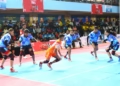
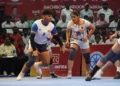
Kabaddi also remains one of India’s strongest medal prospects. The Kabaddi Commonwealth Games 2030 proposal is backed by the sport’s long history of international success. India has dominated Kabaddi at the Asian Games, winning eight of the nine gold medals awarded in the competition.
The growth of the Pro Kabaddi League has further strengthened the sport’s global appeal, making it a strong candidate for inclusion in the Commonwealth Games programme.
Alongside Yoga and Kabaddi, India has also proposed Kho Kho and Mallakhambh, two traditional sports that continue to attract increasing international attention.
A Bigger Vision Beyond 2030
The India Commonwealth Games proposal is not only about increasing medal opportunities for the host nation.
The government also hopes the inclusion of traditional Indian sports will help expand their international popularity and eventually strengthen their cases for future Olympic recognition.
Adding sports such as Yoga and Kabaddi would expose athletes from Commonwealth nations to disciplines that have deep cultural roots in India while encouraging wider global participation.
The expanded programme is also expected to include traditional Commonwealth favourites such as wrestling, cricket, hockey, and badminton, giving India additional opportunities to perform strongly in front of home supporters.
Important Step Towards the 2036 Olympics
The Yoga Commonwealth Games 2030 and Kabaddi Commonwealth Games 2030 proposals are also closely linked to India’s long term sporting ambitions.
Hosting the 2030 Commonwealth Games is widely viewed as an important preparation for India’s bid to host the 2036 Summer Olympic Games. Successfully organising a larger multi sport event would demonstrate the country’s ability to manage world class venues, logistics, and international sporting competitions.
The Commonwealth Games Federation is expected to announce the final list of 15 to 17 sports in the coming months. If India’s proposal is accepted, the 2030 Games could become a landmark event that brings traditional Indian sports to one of the world’s biggest multi sport competitions.