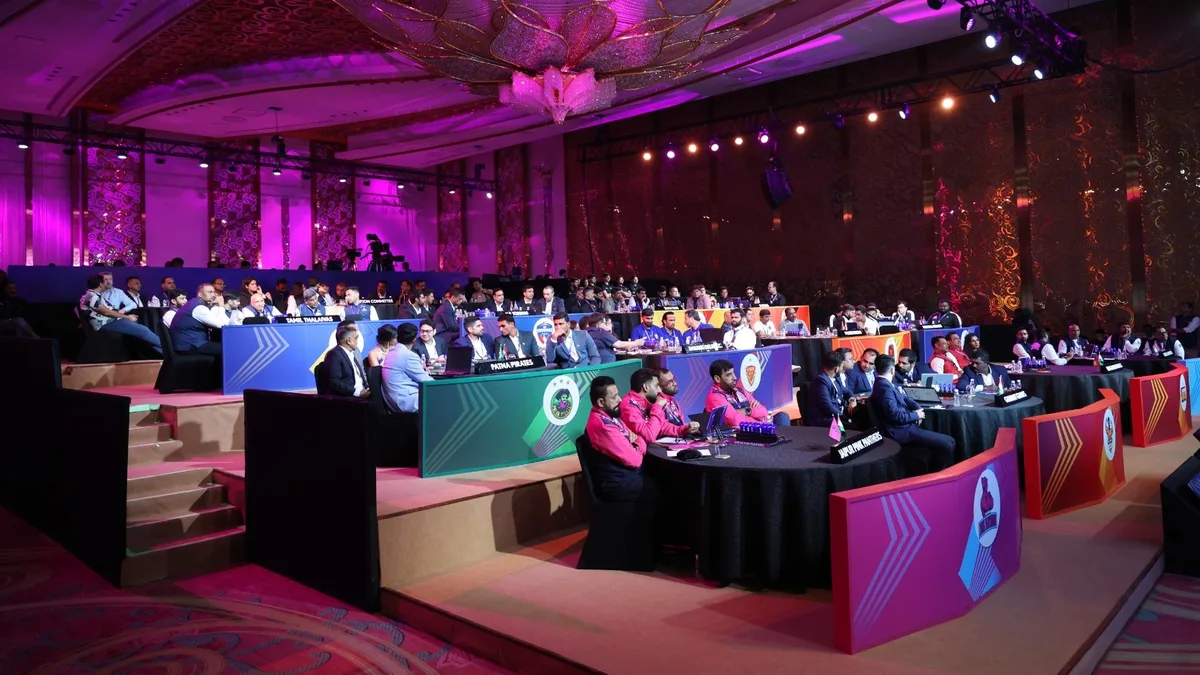
The build up to Pro Kabaddi League Season 12 brought one of the biggest tactical changes in auction history. With every franchise receiving a ₹5 crore purse and more than 500 players available in the auction pool, teams had to rethink how they managed retentions and releases.
The new rules completely changed team planning and created a fresh approach to squad building. This PKL Season 12 Player auction summary explains how franchises used smart retention strategies, purse management, and Final Bid Match cards to prepare for the new season.
The New FBM Rule Changed Everything
The biggest talking point before the auction was the updated Final Bid Match rule. Earlier, teams could only use an FBM card to buy back a player for one season by matching the highest bid.
For Season 12, franchises were allowed to retain players for either one or two seasons through the FBM option. This gave teams more confidence to release even their biggest stars into the auction.
Instead of retaining expensive players directly, teams could now test the market first. If the final auction price looked reasonable, they could simply match the bid and keep the player for a longer period.
This new system became a major part of the Pro Kabaddi League Season 12 auction updated analysis because it completely changed how franchises handled star players.
The FBM Card System
The number of FBM cards depended on how many elite players a franchise retained before the auction.
Teams retaining six elite players received only one FBM card. Teams with five elite retentions got two FBM cards, while franchises keeping four or fewer elite players earned three FBM cards.
This pushed several teams to avoid over retaining players and instead save their purse for bidding wars.
Total Retentions Before Auction
Before the auction started, franchises retained 83 players across three categories.
There were 25 Elite Retained Players, 23 Retained Young Players, and 35 New Young Players.
The Elite Retained Players were the top stars of each squad. Teams were allowed to keep only three elite players to make sure the auction still featured big names.
Young player categories became very important because they helped teams maintain squad depth at lower costs. This allowed franchises to keep enough money available for marquee signings.
Different Team Strategies
Puneri Paltan followed a stability first approach. They retained players like Aslam Inamdar, Mohit Goyat, Pankaj Mohite, Gaurav Khatri, and Abinesh Nadarajan to preserve their successful core. This strategy reduced the need for major auction spending.
Tamil Thalaivas and U Mumba focused on purse flexibility. Tamil Thalaivas heavily backed youth players, while U Mumba kept only a small core. This gave them enough money to fight aggressively for top names during the auction.
Meanwhile, Dabang Delhi K.C. and Patna Pirates used the auction as a price testing system for their own stars.
Delhi matched a massive ₹1.90 crore bid to retain Ashu Malik, while Patna Pirates used the same strategy to keep Deepak Rajender Singh.
These became some of the most shocking retentions ahead of auction PKL12 because franchises willingly risked losing their key players before eventually matching the bids.
Smart Planning Became the Key
Season 12 proved that smart purse management is now more important than emotional retention decisions. Teams that invested in low cost young talent, kept salary flexibility, and used the new FBM system wisely entered the season with stronger and more balanced squads.
The auction showed that modern PKL success is no longer only about buying stars. It is now about building depth, protecting financial balance, and planning for the long term.