Kabaddi has changed dramatically over the past decade. What was once a traditional sport played in villages and local tournaments has now become a fast=paced and highly competitive professional game. Much of this transformation has been driven by the Pro Kabaddi League and several important rule updates.
These changes have increased excitement, improved competitiveness, and attracted millions of new fans. Understanding how kabaddi rules changed the sport helps explain why the game has become one of India’s most popular sporting events.
The 30-Second Raid Rule Changed Everything
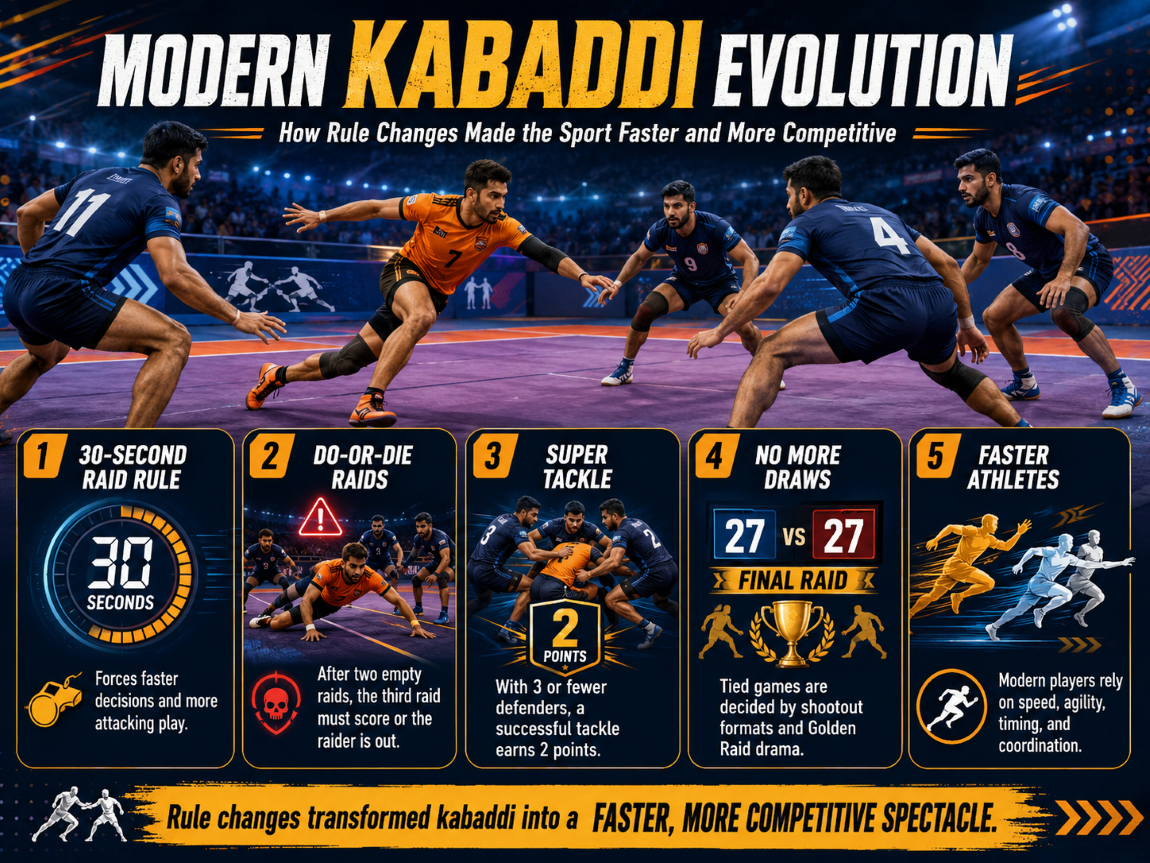
One of the biggest developments in the modern kabaddi evolution was the introduction of the 30-second raid limit.
In the past, raiders could spend more time in the opponent’s half, allowing teams to slow down the game and avoid risks. This often reduced the excitement for spectators.
The new rule forces raiders to make quick decisions and attack within a limited time. As a result, matches are played at a much faster pace, with more action and more scoring opportunities.
This rule alone has had a major impact of rule changes in PKL.
Do-or-Die Raids Increased Pressure
Another important change was the introduction of the Do-or-Die raid rule.
Under this rule, if a team completes two consecutive empty raids, the third raid becomes a Do-or-Die situation. The raider must score a point during that raid. If not, the raider is declared out and the opposing team earns a point.
This rule prevents teams from playing too cautiously. Every raid becomes important, creating tension and excitement for players and fans alike.
It is one of the clearest examples of how kabaddi rules changed the sport and made every moment count.
Super Tackle Added New Drama
The Super Tackle rule has also played a major role in the modern kabaddi evolution.
When a team has three or fewer defenders left on the mat, a successful tackle earns two points instead of one. This gives defenders a chance to fight back even when they are under pressure.
Instead of simply waiting for an All Out, defenders now have an opportunity to change the momentum of the game.
This rule has made matches more balanced and unpredictable.
No More Draws and Tied Games
Modern kabaddi also introduced new methods to decide tied matches.
If teams finish level, a special shootout format is used. If the scores remain tied, the match moves to a Golden Raid where one raid can decide the winner.
These rules ensure that every match produces a result. Fans get a dramatic finish, while players are pushed to perform under pressure.
The removal of draws has been another major impact of rule changes in PKL.
Faster Players for a Faster Game
The new rules have not only changed the game but also changed the athletes.
Modern kabaddi players must be quicker, more agile, and more athletic than ever before. Speed, balance, and rapid movement are now essential skills.
Raiders use advanced techniques to escape tackles, while defenders rely on timing and coordination rather than pure strength.
Conclusion
The modern kabaddi evolution has transformed the sport into a thrilling spectacle. Rules such as the 30-second raid limit, Do-or-Die raids, Super Tackles, and Golden Raids have increased the speed and intensity of every match.
The impact of rule changes in PKL has been enormous, helping kabaddi attract new audiences and reach greater heights. As the sport continues to grow, these innovations will remain key reasons behind its success and popularity around the world.