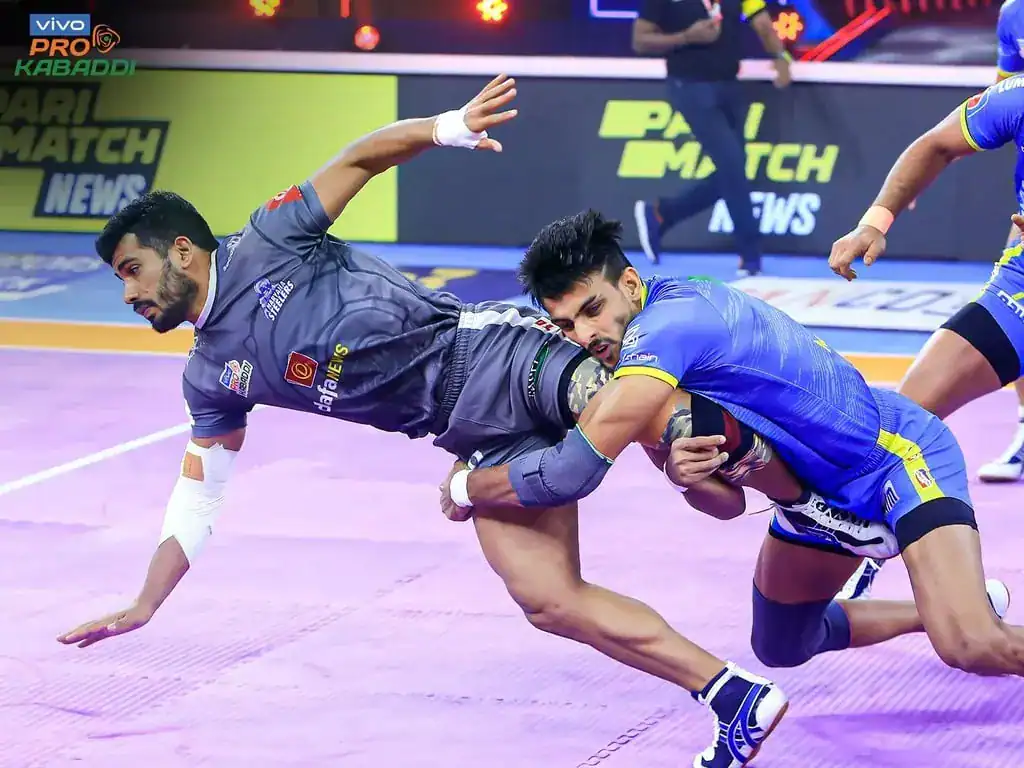
Defence is a crucial part of kabaddi, requiring coordination, quick reactions and an understanding of the raider’s movements. A successful defensive unit must maintain its formation, identify tackling opportunities and prevent the raider from returning safely to the midline.
In standard seven-a-side kabaddi, defenders generally operate as corners, covers and supporting players. Each position has specific responsibilities, but effective defending depends on how well the entire unit works together.
From ankle holds and blocks to defensive traps and do-or-die raids, understanding these tactics helps explain how teams control opponents and create scoring opportunities.
Understanding Defensive Positions in Kabaddi
A kabaddi defence is generally organised around three main groups: corner defenders, cover defenders and players positioned between them.
Their positioning can change depending on the number of defenders remaining on the mat, the raider’s approach and the team’s tactical plan.
Corner Defenders
The left corner and right corner occupy the outer areas of the defensive formation.
They frequently attempt ankle holds and other tackles against raiders approaching the sides of the mat.
Successful corner defending requires:
- Accurate timing when attempting tackles
- Strong grip and body balance
- Awareness of the raider’s footwork
- Coordination with nearby cover defenders
Corner defenders must avoid committing too early. An experienced raider can exploit a premature tackle by changing direction or escaping before support arrives.
Waiting too long can be equally costly, allowing the raider to secure a touch and return safely.
Cover Defenders
The left cover and right cover operate closer to the centre of the defensive formation. Their main responsibilities include blocking the raider’s movement, supporting tackles and protecting spaces between defenders.
When a corner attempts an ankle hold, a cover defender may move forward to assist and prevent the raider from escaping. However, coordination is essential. If a cover moves out of position without support, the raider may exploit the opening.
Effective cover defenders communicate constantly and recognise when to attack or maintain their position.
Supporting Defenders
The remaining players help maintain defensive balance and provide assistance when a tackle begins. They monitor the raider’s movement, protect open spaces and prevent the formation from becoming disconnected.
A common defensive mistake occurs when several players chase the raider simultaneously. This can create gaps that allow the attacker to escape.
A disciplined defensive unit moves together, maintaining enough space to react while remaining close enough to support a tackle.
Common Defensive Techniques in Kabaddi
Kabaddi defenders use several tackling methods depending on the raider’s position, speed and attacking movement.
Each technique requires timing, strength and coordination. An unsuccessful attempt can allow the raider to score and return safely.
1. Ankle Hold
An ankle hold is a defensive technique in which a player grabs the raider’s ankle to restrict movement. It is commonly attempted when the raider moves close to a corner or extends a leg while attempting a touch.
A successful ankle hold can stop the raider long enough for other defenders to complete the tackle. However, the technique requires precise timing.
If the defender reaches too early or fails to secure a strong grip, the raider may pull free and escape.
2. Block
A block involves using body position to obstruct the raider’s path. Defenders often use this technique when the raider attempts to advance or return towards the midline.
A properly executed block reduces the available space and creates an opportunity for teammates to join the tackle.
The defender must maintain balance and avoid leaving another route open.
3. Thigh Hold
A thigh hold involves grabbing the raider around the thigh to restrict movement. The technique is most effective when the raider is within reach and the defender can secure a firm grip.
Strength and balance are important because a raider may attempt to twist or pull away.
Support from teammates can turn an initial thigh hold into a successful team tackle.
4. Waist Hold
A waist hold aims to control the raider by securing a grip around the waist. Defenders may use it when the raider moves close enough for direct contact.
The objective is to limit the attacker’s movement until additional defenders can assist.
An isolated waist hold can be difficult to maintain against a strong or agile raider, making teamwork essential.
5. Dash
A dash is a defensive technique in which a player drives into the raider to push them towards the boundary or away from a scoring position. It is particularly useful when the raider approaches the edge of the mat.
The defender must judge the direction and timing carefully. An unsuccessful dash can create an escape route or allow the raider to score additional points.
Reading the Raider’s Movement
Strong kabaddi defence involves more than physical tackling. Defenders must identify the raider’s preferred techniques and anticipate their next move. Some raiders rely on quick hand touches, while others use footwork, bonus attempts or sudden changes of direction.
By recognising these patterns, defenders can adjust their positioning and prepare coordinated responses. For example, a raider who frequently attacks the corners may face a defensive setup designed to limit movement along the sides.
A player who prefers central attacks may encounter tighter cover positioning.
The objective is to reduce the raider’s options without creating unnecessary gaps.
How Defensive Traps Work in Kabaddi
A defensive trap is a coordinated strategy designed to encourage the raider to enter a particular area before defenders close the available escape routes.
One example involves a corner defender appearing slightly separated from the main formation. The nearby cover remains ready to move forward when the raider approaches. If the raider commits to the opening, the defenders attempt a coordinated tackle.
However, the strategy depends on communication and timing.
If one defender moves too early, the raider may recognise the trap and change direction. Teams practise these situations to ensure that players understand their responsibilities and react together.
Do-or-Die Raids and Defensive Strategy
A do-or-die raid occurs when the attacking team has completed two consecutive empty raids.
Under the usual rules, the third raid must produce a point. If the raider fails to score, the player is declared out.
This situation creates additional pressure on the attacking team and provides defenders with an opportunity to adjust their approach.
How Raiders Approach Do-or-Die Situations
During a do-or-die raid, the attacker must find a scoring opportunity while avoiding a tackle. A quick touch may be the safest option if a defender moves out of position.
However, attempting a difficult attack against a compact defensive formation can increase the risk of elimination.
The raider must balance urgency with careful decision-making.
How Defenders Respond
Defenders can prepare by studying the raider’s preferred attacking moves. They may attempt to guide the attacker towards a particular area of the mat or limit easy scoring opportunities.
Maintaining formation remains essential.
An overly aggressive response can create gaps that allow the raider to secure a touch and escape.
Why Teamwork Matters in Kabaddi Defence
Successful defending depends on the coordination of all seven players rather than individual tackling ability alone. Corner defenders, covers and supporting players must understand when to initiate contact and when to provide assistance.
Communication helps prevent several defenders from committing to the same movement unnecessarily.
It also allows the team to maintain balance when a tackle attempt fails.
A well-organised defensive unit can make scoring difficult even for highly skilled raiders.
Key Kabaddi Defensive Positions and Techniques
| Position or technique | Main responsibility |
| Left corner | Defend the outer left area and initiate tackles |
| Right corner | Protect the outer right area and attempt holds |
| Left cover | Support tackles and protect central spaces |
| Right cover | Coordinate blocks and assist nearby defenders |
| Supporting defenders | Maintain formation and close escape routes |
| Ankle hold | Restrict the raider by securing the ankle |
| Block | Obstruct the raider’s movement using body position |
| Thigh hold | Control movement by gripping the thigh |
| Waist hold | Restrict the raider through a waist grip |
| Dash | Drive the raider towards the boundary |
| Defensive trap | Encourage the raider into a coordinated tackle |
Conclusion
Kabaddi defence combines individual tackling skills with teamwork, positioning and tactical awareness. Corner defenders and covers play important roles in controlling the raider, while supporting players help maintain the formation and complete tackles.
Techniques such as ankle holds, blocks, thigh holds, waist holds and dashes can be effective when executed with proper timing.
Defensive traps and do-or-die situations also demonstrate how tactical decisions influence the outcome of a raid.
Ultimately, the strongest defensive teams are those that remain organised, communicate effectively and respond together to the raider’s movements.